
Why Chemical-Resistant Countertops Matter In Your Laboratory
Quick Summary
Chemical-resistant countertops provide durable, non-porous work surfaces that withstand exposure to acids, solvents, alkalis, heat, and biological contaminants without degrading. Their resistance to chemical damage helps maintain laboratory safety, reduce contamination risks, support accurate testing, and extend the lifespan of laboratory workspaces across research, healthcare, pharmaceutical, industrial, and educational environments.
In any laboratory where chemicals are handled, mixed, stored, or tested, the work surfaces beneath every experiment carry a significant responsibility. Chemical-resistant countertops are not simply a material preference; they are a foundational safety requirement. A surface that degrades under chemical exposure creates contamination risks, compromises experimental accuracy, and puts laboratory personnel in danger.
For labs operating in pharmaceutical, research, healthcare, industrial, and educational settings, understanding what chemical resistance means and why it matters is the first step to building a safer, more effective workspace.
LOC Scientific has equipped thousands of laboratories with the right surfaces since 1986, and the lessons from those projects are clear: the right countertop makes everything else in the lab work better.
What Makes a Countertop Chemically Resistant
Not all laboratory surfaces labeled as chemical-resistant offer the same level of protection. True chemical resistance refers to a material’s ability to withstand exposure to acids, alkalis, solvents, oxidizing agents, and biological fluids without degrading, discoloring, swelling, or becoming porous. A genuinely resistant countertop maintains its structural integrity after repeated contact with these substances, even under conditions that include heat and moisture.
The key properties that define a high-performing chemical-resistant countertop include non-porosity to prevent absorption, surface hardness to resist abrasion and scratching, thermal stability to handle heat from equipment or chemical reactions, resistance to a broad spectrum of chemical families, and ease of cleaning and decontamination. Materials that check all of these boxes are the ones that serve laboratories reliably over many years.
The Risks of Inadequate Surface Protection
When a laboratory countertop is not genuinely resistant to the chemicals used in that space, the consequences range from inconvenient to dangerous. A compromised surface can absorb chemicals, creating reservoirs of contamination that persist even after cleaning. This is particularly hazardous in biological or pharmaceutical labs where cross-contamination can invalidate results or introduce health risks.
Surface degradation also creates uneven textures where bacteria, fungi, and residue can accumulate. For labs subject to regulatory standards, a deteriorating countertop can trigger compliance failures during inspections. Beyond safety and compliance, frequent replacement of inadequate surfaces is a high operational cost that careful material selection at the outset can entirely avoid.
Epoxy Resin: The Gold Standard for Chemical Resistance
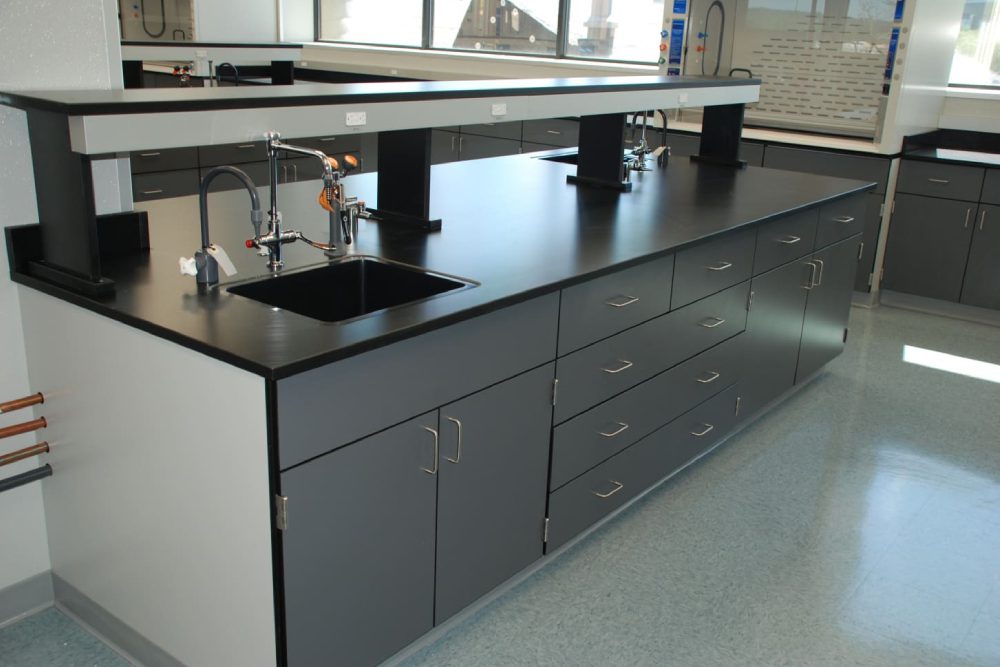
Among all available laboratory countertop materials, epoxy resin countertops are widely recognized as the benchmark for chemical resistance. Produced through a continuous-casting method, epoxy resin forms a dense, non-porous solid surface that resists virtually all common laboratory chemicals, including strong acids like hydrochloric and sulfuric acid, solvents like acetone and methanol, and oxidizing agents like bleach and hydrogen peroxide.
Epoxy resin countertops are also flame-resistant and thermally stable, meaning they can handle heat from Bunsen burners, hot plates, and autoclaves without warping or cracking. Their non-porous nature makes them straightforward to clean and decontaminate, which is critical in labs with biohazardous materials. LOC Scientific provides epoxy resin countertops matched with compatible sinks and accessories, creating complete chemical-resistant work areas from a single trusted source.
Stainless Steel and Its Role in Chemical-Resistant Environments
Stainless steel is another proven material in chemical-resistant laboratory settings. Stainless steel lab countertops offer strong resistance to moisture, bacteria, fungi, and moderate chemical exposure, along with the added benefit of heat resistance up to 1500 degrees Fahrenheit. These properties make stainless steel a reliable choice in pharmaceutical manufacturing, food science, and healthcare labs where sterilization and hygiene are top priorities.
One consideration with stainless steel is that it is not impervious to all chemicals, particularly highly concentrated halide compounds and some strong acids over time. For labs handling these specific substances, epoxy resin may offer more comprehensive protection. However, for labs where the primary concern is moisture, heat, and general chemical exposure, stainless steel remains one of the strongest options available.
Phenolic Resin as a Mid-Range Chemical-Resistant Option
For laboratories where chemical exposure is moderate and budget is a practical consideration, phenolic resin countertops provide reliable performance at a more accessible price point. Produced by compressing resin-saturated paper layers under heat and pressure, phenolic resin surfaces resist most common laboratory chemicals, moisture, and fungi.
While phenolic resin does not offer the same level of flame resistance or broad chemical protection as epoxy resin, it is a strong performer for educational labs, general research environments, and industrial testing areas where the chemicals in use fall within a moderate range of aggression. Phenolic resin is also a popular choice for lab furniture casework that must complement chemical-resistant countertops.
How LOC Scientific Approaches Chemical-Resistant Countertop Selection
LOC Scientific treats countertop selection as a technical decision, not a catalog choice. Every project begins with an assessment of the chemicals in use, the frequency of exposure, the cleaning protocols in place, and the regulatory requirements that apply. This information shapes the recommendation, ensuring that the selected chemical-resistant countertops are precisely matched to the demands of the lab rather than simply meeting a general standard.
Our team also considers the broader lab environment, including the pairing of countertops with appropriate laboratory sinks, backsplashes, and service fixtures to create fully integrated, chemical-resistant work areas. This comprehensive approach has made us a trusted partner for over 10,400 laboratory projects across healthcare, pharmaceutical, research, education, government, and industrial sectors.
Investing in the Right Surface from the Start
Choosing chemical-resistant countertops is not simply about meeting minimum requirements. It is about creating a laboratory environment where personnel are protected, experiments are not compromised by surface contamination, and the infrastructure supports the work for many years without unplanned replacement.
Our American-made countertops are designed with this long-term perspective in mind, combining material quality with expert customization and professional installation services so that every surface performs exactly as it should from day one.
To find out which chemical-resistant countertops are right for your laboratory, contact LOC Scientific and receive expert guidance tailored to your specific environment.
FAQs
Chemical resistance refers to a countertop material’s ability to withstand exposure to acids, solvents, alkalis, and biological agents without degrading, absorbing chemicals, or becoming a contamination risk within the laboratory.
Epoxy resin provides broad resistance to the majority of chemicals used in laboratory settings, including strong acids, solvents, and oxidizers, making it one of the most comprehensively protective countertop materials available.
With proper maintenance, high-quality epoxy resin and stainless steel countertops can serve a laboratory reliably for many years, often outlasting lower-grade surfaces by a significant margin when appropriately selected for the application.