
A walk-in fume hood is a floor-mounted enclosure for apparatus too tall or bulky for a benchtop hood. Size it by the equipment you plan to roll in and the airflow your exhaust system can support, then confirm performance with ASHRAE 110 testing. This guide covers features, sizing, ducting, and how it compares with a standard hood.

Walk-In Fume Hood: Features, Sizing, Installation and Benefits
A walk-in fume hood is a fundamental piece of laboratory equipment for professionals who work with hazardous fumes and chemicals. It is a floor-mounted enclosure that lets you roll in tall or bulky apparatus while the exhaust system carries dangerous vapors away from the lab. By containing those vapors, it protects workers from harmful exposure to toxic substances.
However, there is more to these hoods than exhausting contaminated air. These systems are designed with advanced features that improve efficiency and enhance safety. That makes them valuable for labs that handle volatile chemicals or oversized equipment.
Already know what you need? View our walk-in hood models, sizes and airflow data, or keep reading to learn how to size, install and specify one.
What Is a Walk-In Fume Hood
and When Is It Used?
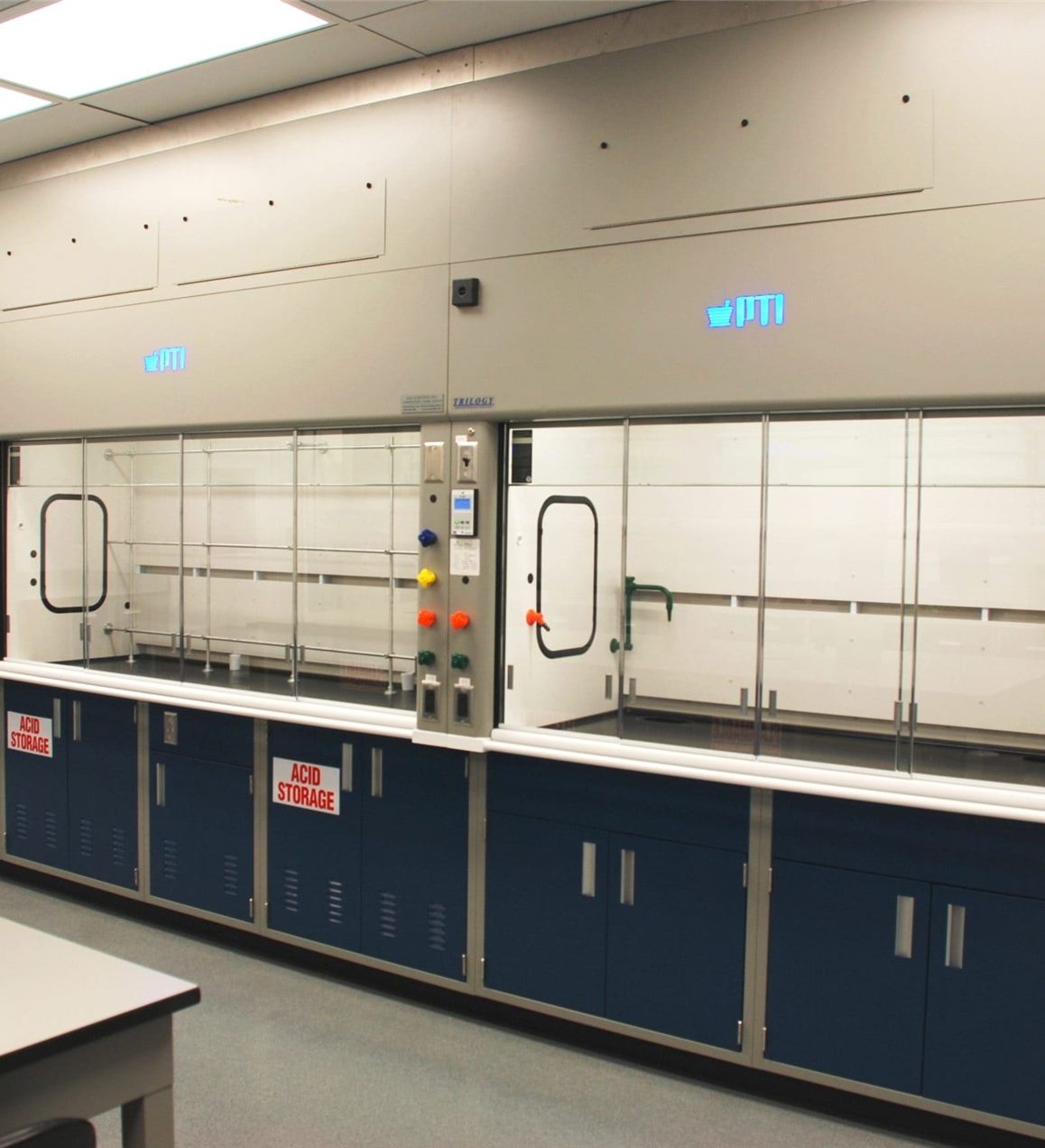
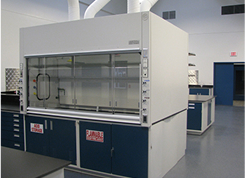
A walk-in fume hood is a large, enclosed ventilation system meant for spacious laboratory environments. Unlike benchtop models, it stands on the laboratory floor and has a tall opening, so you can roll in large equipment, reaction vessels or a portable workstation. It is typically used in pharmaceutical, chemical, and industrial labs, where large-scale operations occur. These units draw in contaminated air and exhaust it, protecting workers from harmful fumes.
One safety point matters here. The name suggests you can step inside, but Prudent Practices in the Laboratory advises that no one should walk into a chemical hood while it is operating and contains hazardous chemicals. For the same reason, SEFA 1 uses the term floor-mounted hood instead of walk-in hood.
These hoods come with safety features like alarms, monitors, and adjustable airflow systems. This creates a controlled environment for hazardous work. Our own walk-in hood, for example, includes an audible airflow monitor.
Typical Uses for a Walk-In Hood
- Research and development labs with large experimental or pilot-scale apparatus
- Industrial testing facilities that handle oversized testing equipment
- Teaching laboratories with large demonstration equipment
- Pharmaceutical and chemical processing labs that use large reaction vessels
- Materials science labs that work with furnaces and other large processing equipment
A walk-in unit is not the answer to every problem. SEFA 1 says it is not prudent to use a floor-mounted hood for work with highly toxic materials, and perchloric acid work needs a purpose-built perchloric acid hood. If that is your application, start with our overview of laboratory fume hoods.
Key Features of a Walk-In Fume Hood
One of the main benefits of walk-in hoods is their spacious design. They can accommodate large equipment and portable workstations. They are ideal for tasks that require extended interaction with apparatus.
-
Ventilation System:
The ventilation system is also a standout feature. A powerful fan and exhaust system pulls air through the sash opening and carries dangerous vapors away, expelling them outdoors through ductwork. Airflow can be matched to the laboratory’s needs to maintain a secure environment for workers, and fume hood exhaust fans are available to complete the system.
-
Customization Options:
Customization options are available. Labs can specify optional service fixtures, fan options and sealed, energy-efficient lighting to meet their specific needs. Our fume hood accessories page shows what can be added.
-
Safety:
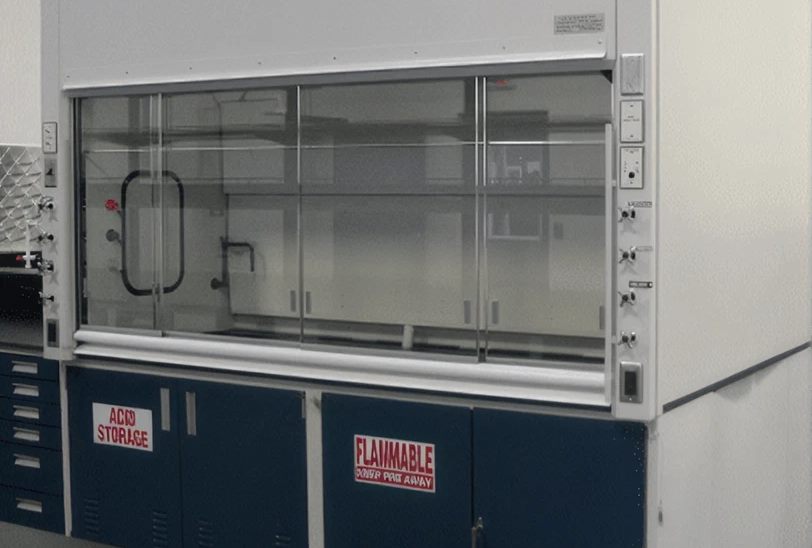
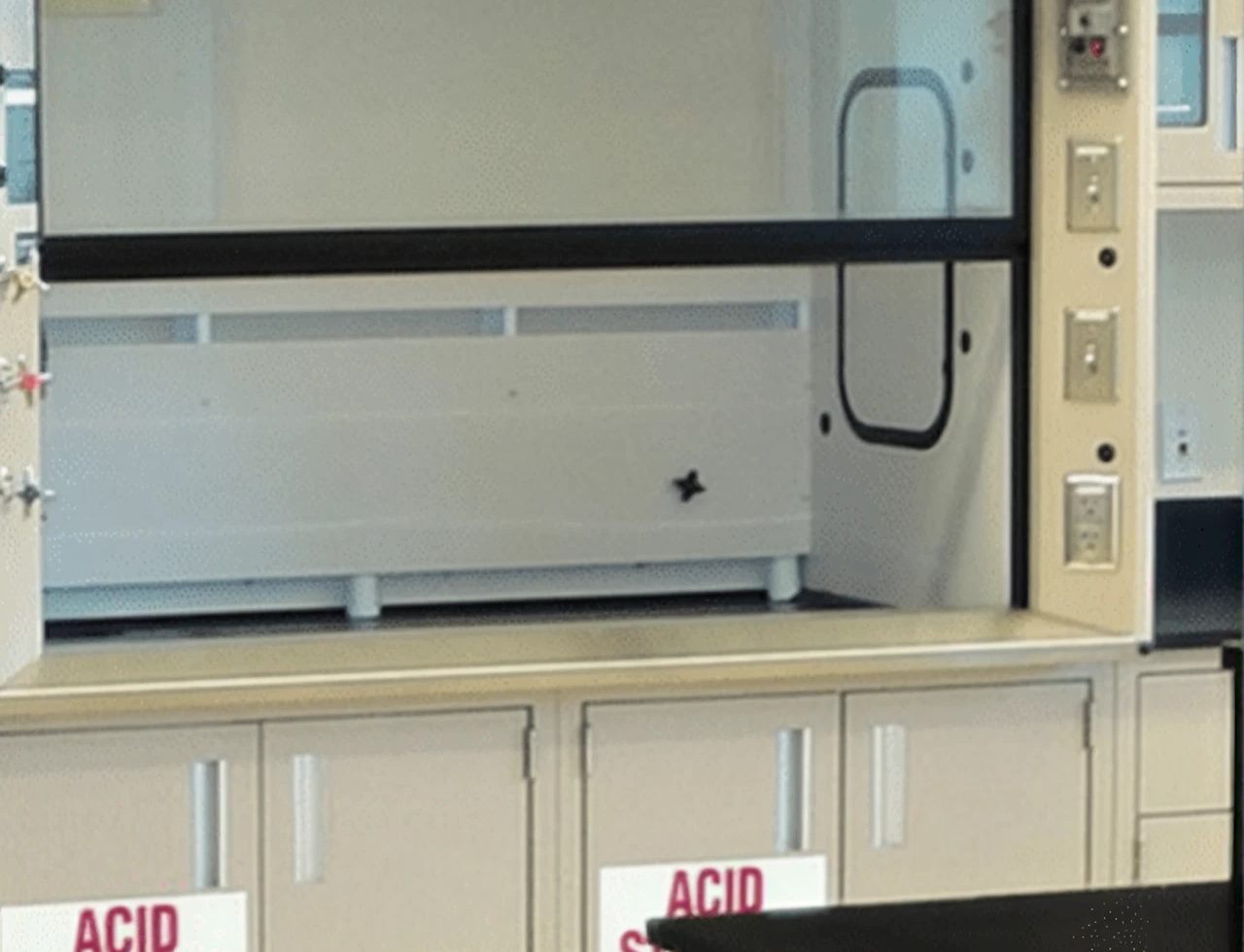
Safety is a top priority in any lab. Our walk-in hood uses two independent, vertically rising sashes with laminated safety glass, plus an audible airflow monitor that helps confirm proper ventilation during use.
-
Durability:
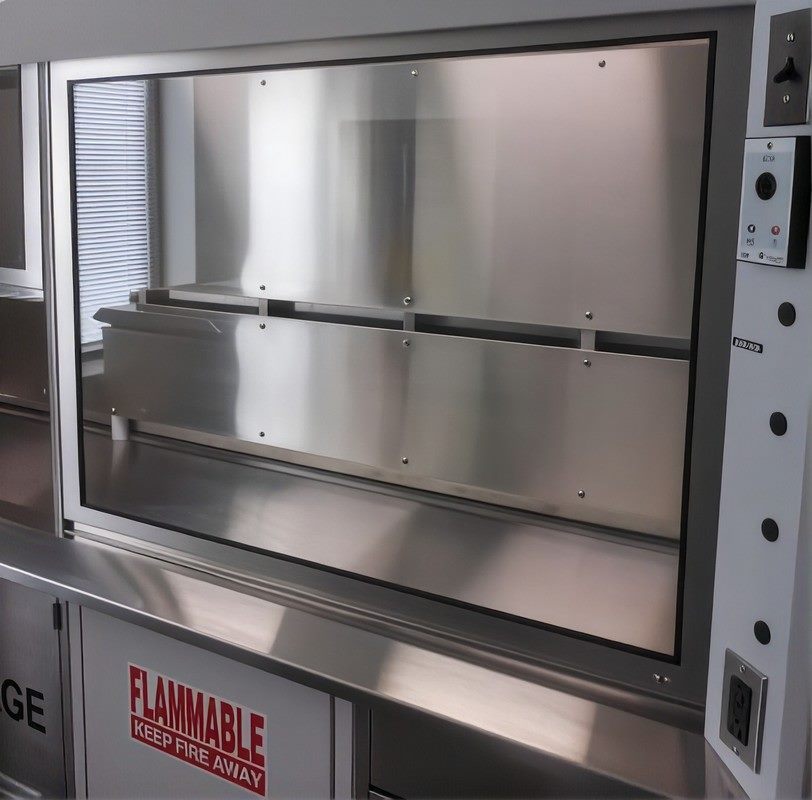
Durability is another key benefit. Our walk-in hood uses double-wall construction with a Resin-Chem chemical-resistant liner, which suits demanding lab environments. Removable access panels also make cleaning and maintenance easier.
Walk-In Fume Hood Sizing, Airflow and Containment
Start sizing with the equipment, not the hood. Measure the height, width and footprint of the largest item you plan to roll in, then add working clearance on every side. Choose the hood size that fits that envelope with room to spare.
Airflow follows from the opening. Required exhaust volume is face velocity multiplied by the open sash area, a calculation our CFM guide walks through. A taller, wider opening therefore needs more air than a benchtop hood running at the same face velocity.
The published figures for our walk-in hood show the effect. At 100 FPM, the 48-inch model moves 975 CFM and the 96-inch model moves 2,175 CFM. The summary below lists all five sizes, and the full specification table adds collar sizes and static pressure.
| Hood size | CFM at 75 FPM | CFM at 100 FPM | CFM at 125 FPM |
|---|---|---|---|
48 |
731 |
975 |
1219 |
60 |
956 |
1275 |
1575 |
72 |
1181 |
1575 |
1969 |
84 |
1406 |
1875 |
2344 |
96 |
1631 |
2175 |
2719 |
Face velocity is only part of containment. SEFA 1 describes 60 to 100 FPM as the most widely accepted range of average face velocities, and Prudent Practices advises against velocities approaching or exceeding 150 FPM because of turbulence. Your safety officer should set the target for your procedures.
SEFA 1 also notes that floor-mounted hoods are particularly susceptible to variations in face velocity across the opening. For hoods with several vertical sashes, it recommends fully opening only one sash during operation. Build that habit into user training.
Finally, verify performance rather than assume it. ASHRAE 110 defines face velocity, smoke visualization and tracer gas tests, and it covers as-manufactured, as-installed and as-used conditions, as AIHA explains. Our own guide to ASHRAE 110 inspections covers what to expect.
Walk-In Fume Hood Installation and Ducting Requirements
A walk-in hood is part of an exhaust system, not a stand-alone appliance, so plan the building around it early. These are the points to settle first.
The appendix to OSHA’s Laboratory standard says laboratory air should not be recirculated and should be exhausted directly outdoors.
The static pressures in our walk-in hood table are for the hood only. Add the pressure drop of the duct system, because the total determines which exhaust blower you need.
Check room size, heat load and the air changes your lab requires before you size the exhaust.
Prudent Practices advises building hoods and their exhaust ducts from nonflammable materials. Our fume hood duct page lists the fittings we supply.
Decide early where any optional fixtures will mount, because the hood is drilled to match.
Keep the hood away from doorways, busy aisles and drafty windows, as our fume hood installation guide explains.
Air balance matters too. OSHA’s guidance calls for a negative pressure differential between exhausted and supplied air, so your HVAC design needs to account for the extra air a large opening removes.
Once the hood is in place, commission it. The as-installed test described by AIHA is performed in the actual lab before occupancy. We handle lab equipment installation, and our team also offers fume hood testing and calibration.
Walk-In Fume Hood vs. Standard
Benchtop Fume Hood
Both hood types contain fumes with moving air, but they solve different problems. Use this comparison to decide which fits your apparatus and your building.
| Feature | Walk-in hood | Standard benchtop hood |
|---|---|---|
Placement |
Stands on the laboratory floor |
Sits on a workbench or base cabinet |
Best for |
Very tall or large apparatus, pilot-scale setups and portable workstations |
Routine bench-scale chemical work |
Loading |
Equipment rolls in through the tall opening |
Equipment is lifted onto the work surface |
Exhaust demand |
Larger opening, so more CFM at the same face velocity |
Smaller opening, so less CFM |
Containment watch-points |
Face velocity can vary across a wide opening; open one sash fully at a time |
A smaller opening is typically easier to keep uniform |
Highly toxic work |
Not recommended by SEFA 1 for highly toxic materials |
Choose a hood type matched to the hazard |
If tall apparatus is your only issue, Prudent Practices notes that a distillation (knee-high) hood puts the work surface closer to the floor and provides extra vertical space. Our ducted vs. ductless comparison helps with the exhaust decision, and our fume hood vs. laminar flow hood article covers a different choice entirely.
Benefits of Using a Walk-In Fume Hood
The most significant benefit of a walk-in fume hood is increased safety. It isolates hazardous fumes and chemicals and them away from the workspace preventing harmful exposure. Workers can run large setups from the sash opening, confident in their protection.
Improved air quality is another advantage. A walk-in hood keeps the lab environment cleaner and more breathable by capturing toxic gases, vapors, and dust at the source. This allows workers to concentrate on their work without worrying about the risks of inhaling hazardous substances.
The spacious design also enhances productivity. With more room to organize tools and equipment, workers can perform tasks more efficiently. Better organization reduces clutter and streamlines workflows, which can lead to faster, more accurate results. Keep that clutter under control, though: large equipment placed incorrectly can disrupt airflow.
Walk-in hoods are versatile and used in a variety of industries, including pharmaceuticals, biotechnology, and environmental testing. Their adaptability makes them important in labs with diverse operations. They support functions like research and development or large-scale manufacturing.
Regulatory compliance is another important benefit. Laboratories handling hazardous materials must meet safety standards, and a properly specified, installed and maintained walk-in fume hood helps. OSHA’s Laboratory standard, 29 CFR 1910.1450, requires a chemical hygiene plan that ensures fume hoods are functioning properly, while ANSI/ASSP Z9.5 sets minimum requirements and best practices for laboratory ventilation. Monitored airflow and regular testing keep the workspace in line with those protocols.
How LOC Scientific Can Help With Your Walk-In Fume Hood Project
LOC Scientific specializes in designing, selling, and installing high-quality laboratory products. Our expertise allows us to offer customized solutions to fit your laboratory’s needs. We offer a wide range of fume hoods, from basic to fully customizable units, to meet the demands of any environment.
Our team is committed to delivering excellent customer support throughout the process. From helping you select the right fume hood to guiding you through installation, we are with you every step of the way.
Our walk-in hood is built to last, with double-wall construction and a chemical-resistant liner.
Upgrade Your Lab With a Walk-In Hood
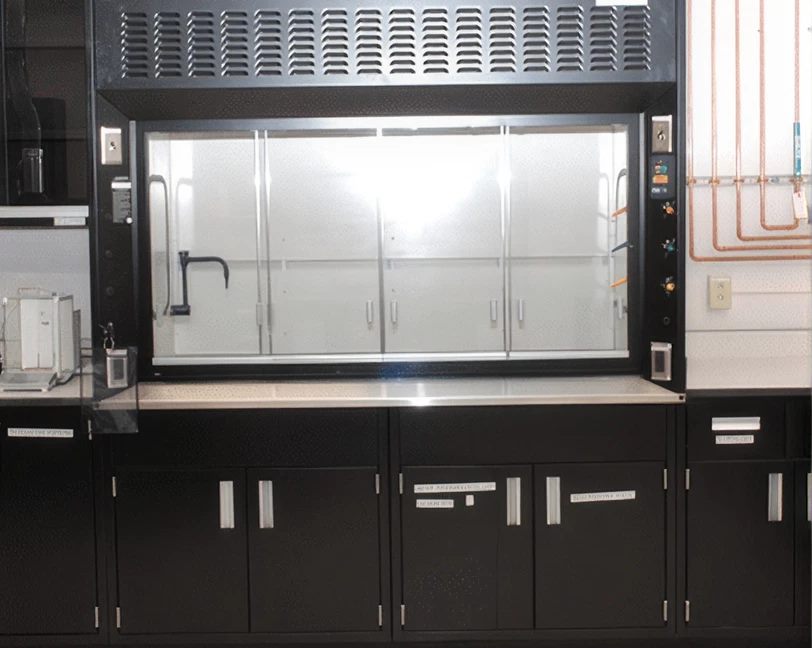
If you’re looking to elevate the safety and productivity of your lab, a walk-in fume hood is a great solution. We specialize in designing, selling, and installing top-quality walk-in hoods that can be customized to meet your specific needs.
Our experienced team is here to guide you through every step, from selecting the right fume hood to a smooth installation process.
Contact us today to learn how we can help create a safer, more efficient workspace for your laboratory.
Ready to buy? View our walk-in hood, review the specifications and sizes, then request a design for your lab.
Related Documents:
Frequently Asked Questions
A walk-in hood is used when apparatus is too tall or bulky for a benchtop hood. Typical examples include pilot-scale reactors, large reaction vessels, furnaces and portable workstations rolled in through the tall opening. The exhaust system captures fumes and vapors at the opening, which protects the people working there. It is common in pharmaceutical, chemical, industrial and research labs.