
Epoxy Vs. Stainless Steel Countertops: Which Material Suits Your Laboratory?
Quick Summary
Epoxy resin and stainless steel are two of the most widely used laboratory countertop materials, each offering distinct performance advantages based on laboratory requirements. While epoxy resin provides exceptional resistance to acids, solvents, and other aggressive chemicals, stainless steel excels in sterile environments requiring high heat tolerance and easy sanitization. Comparing their chemical resistance, durability, maintenance needs, thermal performance, and long-term value helps laboratories select the most suitable countertop material for their specific applications.
When planning or upgrading a laboratory, countertop selection often comes down to two dominant options: epoxy vs. stainless steel countertops. Both materials are trusted across scientific environments worldwide, but they are not interchangeable. Each has distinct strengths, limitations, and ideal use cases. Understanding those differences clearly is what allows laboratory planners, directors, and facilities managers to choose the right surface for their specific conditions.
LOC Scientific has guided thousands of laboratories through this decision, and this comparison draws on that experience to help you get it right from the start.
Explore the full range of laboratory countertops available from LOC Scientific to see how these materials look in practice.
Chemical Resistance
Chemical resistance is often the first criterion laboratory teams evaluate. Epoxy resin countertops are produced as a solid, non-porous surface through a continuous-casting method, which makes them resistant to a broad spectrum of chemicals, including strong acids, solvents, alkalis, and oxidizing agents. This broad protection is why epoxy resin is the standard choice in pharmaceutical research, chemistry, and industrial testing labs.
Stainless steel vs. epoxy countertops in terms of chemical resistance is not a clear win for steel. Stainless steel countertops resist many chemicals and hold up well against corrosion, but certain concentrated acids and halide compounds can attack the surface over time.
Hygiene and Sterilization
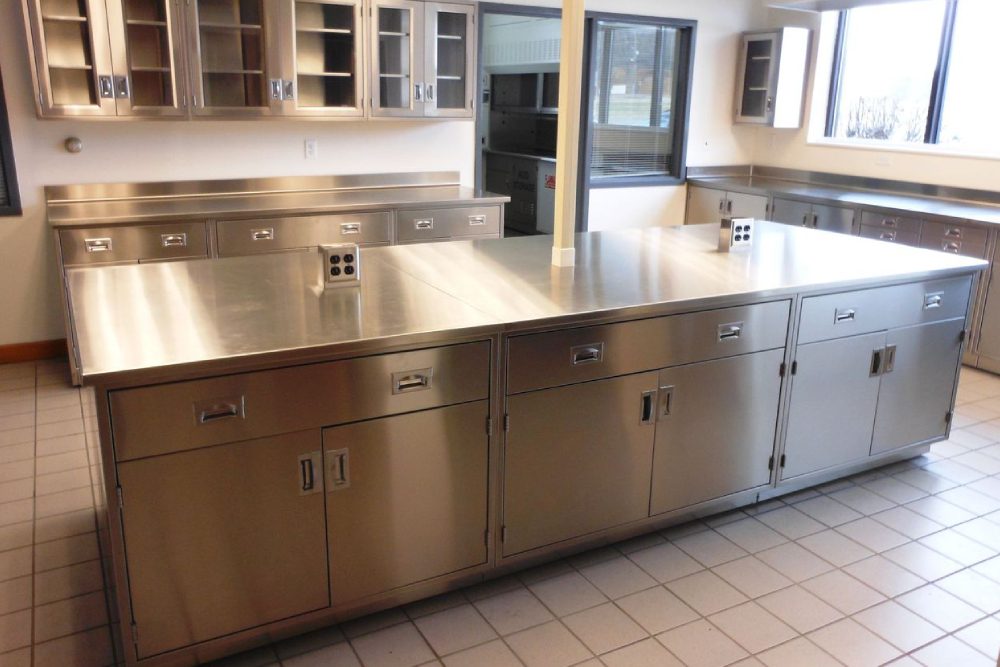
In pharmaceutical, healthcare, and cleanroom environments, hygiene requirements often drive material selection. Stainless steel is non-porous and one of the easiest surfaces to sterilize using steam, UV, or chemical disinfectants. It does not absorb moisture or support microbial growth, which makes it the preferred material in sterile processing areas and food science labs.
Epoxy resin is also non-porous and resists bacterial and fungal growth, making it suitable for life science labs and clinical environments. However, stainless steel has a slight edge in sterile processing scenarios where autoclaving or repeated high-temperature sterilization is part of the workflow, as it handles extreme heat more readily than epoxy resin.
Thermal and Impact Resistance
Stainless steel withstands temperatures up to 1500 degrees Fahrenheit, making it exceptionally heat-resistant for labs that use high-temperature equipment, open flames, or autoclaves. It is also highly impact-resistant, capable of handling the weight and force of heavy equipment without cracking or chipping.
Epoxy resin is flame-resistant and handles the heat generated by standard laboratory equipment such as hot plates and Bunsen burners without warping. However, it does not match stainless steel’s extreme heat tolerance.
Durability and Maintenance
Both materials are durable, but they wear differently. Stainless steel develops surface scratches over time, particularly in environments where tools and equipment are regularly moved across the surface. These scratches, while cosmetic, can make the surface more difficult to clean thoroughly. Stainless steel also shows fingerprints and water spots, which may be a consideration in labs where visual cleanliness matters.
Epoxy resin is highly resistant to scratching and maintains a consistent surface texture throughout its working life. It requires periodic maintenance to address any surface wear, but when properly cared for, it retains its chemical resistance and appearance for many years.
Cost and Value
Both epoxy resin and stainless steel represent a meaningful investment compared to laminate alternatives, and both deliver strong long-term value when matched to the right application. Stainless steel fabrication costs can vary significantly based on grade, thickness, and configuration. Epoxy resin pricing also depends on thickness and size but tends to be competitive when evaluated over the full service life of the countertop.
Our team of specialists helps clients evaluate both options with real data from their lab environment, including chemical profiles and compliance requirements. Pairing the right countertop with appropriate lab furniture and casework also plays a role in the overall value calculation.
Which Material Suits Your Laboratory
The stainless steel vs. epoxy countertops question does not have a universal answer, but it does have an answer for every specific lab. If your priority is sterile processing, extreme heat resistance, or moisture-heavy environments, stainless steel is the stronger candidate. If your lab handles a wide range of chemicals, requires broad resistance to acids and solvents, and prioritizes a durable, low-maintenance surface, epoxy resin is the more comprehensive solution.
Many laboratories benefit from using both materials in different zones, with epoxy resin on primary work surfaces and stainless steel at sink areas or in zones with specific heat requirements. LOC Scientific’s laboratory design services help plan exactly these kinds of integrated solutions.
Ready to choose the right countertop for your laboratory? Contact LOC Scientific today to speak with an expert and get a solution designed specifically for your lab.
FAQs
Epoxy resin is generally the better choice for chemistry research labs due to its broad resistance to acids, solvents, and oxidizers, making it more reliable for the wide range of chemicals typically encountered.
Stainless steel resists many chemicals effectively but can be vulnerable to concentrated halide compounds and certain strong acids over time, so it is best evaluated against the specific chemicals used in your lab.
Epoxy resin countertops require routine cleaning with appropriate lab-grade products and periodic inspection for surface wear, but they are generally considered low-maintenance given their durability and resistance to common lab chemicals.