
Fume Hood Safety Guidelines In Your Laboratory
Quick Summary
A fume hood is only as protective as its last test. OSHA’s Laboratory Standard requires hoods to be maintained and functioning whenever in use, and annual containment testing under ASHRAE 110 is how that gets verified. Daily habits at the sash matter as much as the certificate on the frame.
Maintaining proper fume hood safety practices is one of the most important responsibilities in any laboratory that handles volatile or hazardous chemicals. A fume hood is often the primary engineering control protecting workers from harmful vapors and fumes, but its effectiveness depends entirely on proper installation, regular certification, and consistent use according to established guidelines.
Understanding OSHA’s Laboratory Standard
The Occupational Safety and Health Administration requires, under its Laboratory Standard, found at 29 CFR 1910.1450, that laboratory fume hoods be maintained and function properly whenever they are in use. This regulation places responsibility on employers to ensure that fume hoods are not only installed correctly but also regularly inspected and tested throughout their operational life.
Meeting this requirement involves more than a one-time installation check, since ongoing performance directly affects worker safety on a daily basis.
Why Regular Certification Testing Matters
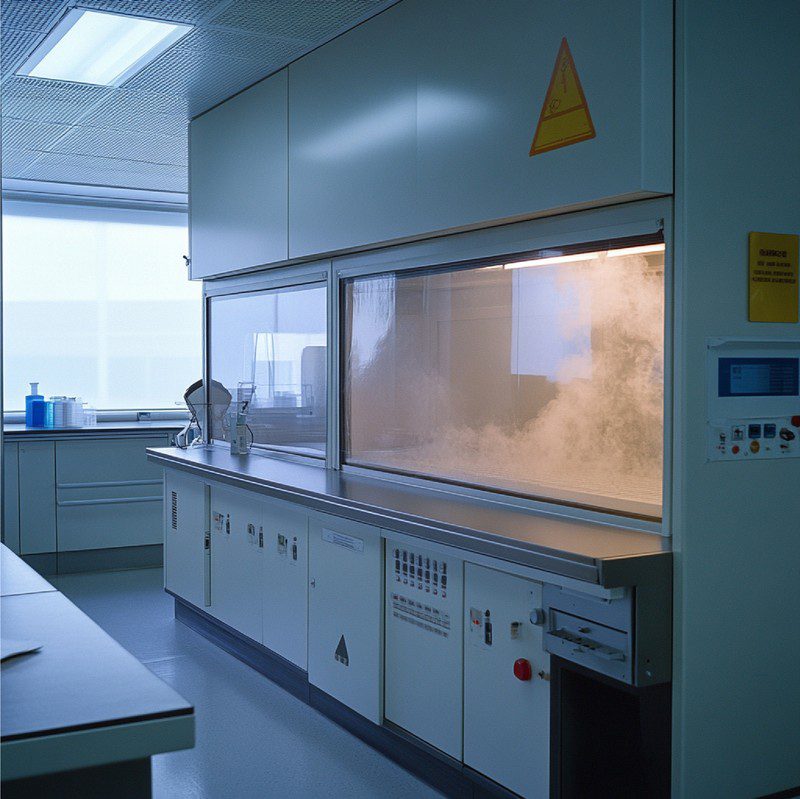
Fume hood certification standards typically call for annual performance testing to confirm that a hood is containing hazardous vapors effectively. The method most testing follows is ASHRAE 110, which sets out flow visualization using a visible tracer, face velocity measurement, and a tracer gas containment test conducted with a mannequin at the sash. ANSI/AIHA Z9.5 covers the wider laboratory ventilation system the hood depends on, and many institutions set their own acceptance criteria on top of both.
General laboratory hoods require a face velocity between eighty and one hundred twenty feet per minute, while hoods used for more hazardous materials may require different ranges depending on the specific application.
Common Reasons a Fume Hood Fails Inspection
Several issues can cause a fume hood to fail its certification testing. An inoperable exhaust fan, obstructed airflow caused by equipment or chemicals stored improperly inside the hood, or reverse airflow escaping from the enclosure are all common culprits.
Fume hoods should never be used as long-term chemical storage, since stored items can disrupt the airflow pattern the hood relies on to function safely, ultimately compromising the protection it is meant to provide.
Best Practices for Everyday Fume Hood Use
Beyond formal certification, daily habits significantly affect how well a fume hood protects laboratory workers. Keeping the sash at the recommended height, typically eighteen inches or less, helps maintain proper airflow, while keeping materials at least six inches back from the sash opening reduces the chance of turbulence disrupting containment.
Users should also avoid placing bulky equipment directly against the back baffle of the hood, since this can block airflow pathways that are essential to the hood’s design.
Training Requirements for Fume Hood Users
Proper training is a foundational part of fume hood safety guidelines, since even a well-maintained hood cannot protect workers who do not understand how to use it correctly. Training should cover how to check that airflow indicators show the hood is functioning, how to position the sash appropriately, and what to do in the event of an emergency such as a power failure.
Laboratories should ensure that every new hood user receives this training before working with hazardous chemicals inside the hood.
What to Do if a Fume Hood Malfunctions
If a fume hood shows signs of malfunction, such as an inconsistent airflow indicator or an inspection tag that has expired, it should be taken out of service immediately.
This means closing the sash, clearly labeling the hood as out of service, and notifying the appropriate safety personnel or facilities team.
Continuing to use a malfunctioning fume hood, even temporarily, significantly increases the risk of chemical exposure for everyone in the surrounding lab space.
How Equipment Placement Affects Fume Hood Performance
The location of a fume hood within the laboratory can affect its performance just as much as the equipment itself.
Fume hoods placed too close to doors, high-traffic walkways, or supply air diffusers are more susceptible to airflow disruptions that can compromise containment, even when the hood itself is functioning properly.
Thoughtful placement during the design phase of a laboratory helps prevent these avoidable performance issues down the road.
Emergency Procedures Involving Fume Hood Use
Every laboratory should have a clear emergency action plan that addresses what to do if a fume hood malfunctions while hazardous chemicals are in use, particularly in the event of a power failure or ventilation system disruption.
Staff should know how to safely secure any chemicals inside the hood, evacuate if necessary, and report the issue promptly. Practicing these procedures periodically, rather than only reviewing them on paper, helps ensure staff can respond calmly and effectively if a real emergency occurs.
Building a Culture of Safety Around Fume Hood Use
Rules and equipment alone cannot guarantee safety if the broader laboratory culture does not reinforce their importance.
Encouraging staff to report concerns without hesitation, recognizing careful practices during routine reviews, and making safety expectations part of everyday conversation all contribute to a laboratory environment where proper fume hood use becomes second nature rather than an afterthought.
Over time, this kind of consistent reinforcement does more to prevent incidents than any single policy or piece of equipment on its own.
How LOC Scientific Supports Fume Hood Safety
LOC Scientific designs, sells, and installs laboratory furniture, fume hoods, and accessories built to support the safety standards laboratories depend on every day. Our team brings deep experience and knowledge to every installation, ensuring your fume hoods are set up correctly from the start and positioned appropriately within your laboratory layout.
Our equipment is made in the USA, so we maintain close quality control throughout the manufacturing process, and our support team stays available after installation when questions come up.
Contact LOC Scientific today for expert guidance on selection, installation, and ongoing safety support.
Frequently Asked Questions
Most laboratories certify fume hoods on an annual basis, though hoods should also be tested any time they are moved, repaired, or if performance issues are suspected between scheduled inspections.
General use fume hoods typically require a face velocity between eighty and one hundred twenty feet per minute, though hoods designed for more hazardous materials may have different specified ranges.
No, fume hoods should not be used for long term chemical storage, since stored items can obstruct airflow and compromise the hood’s ability to contain hazardous vapors effectively.