
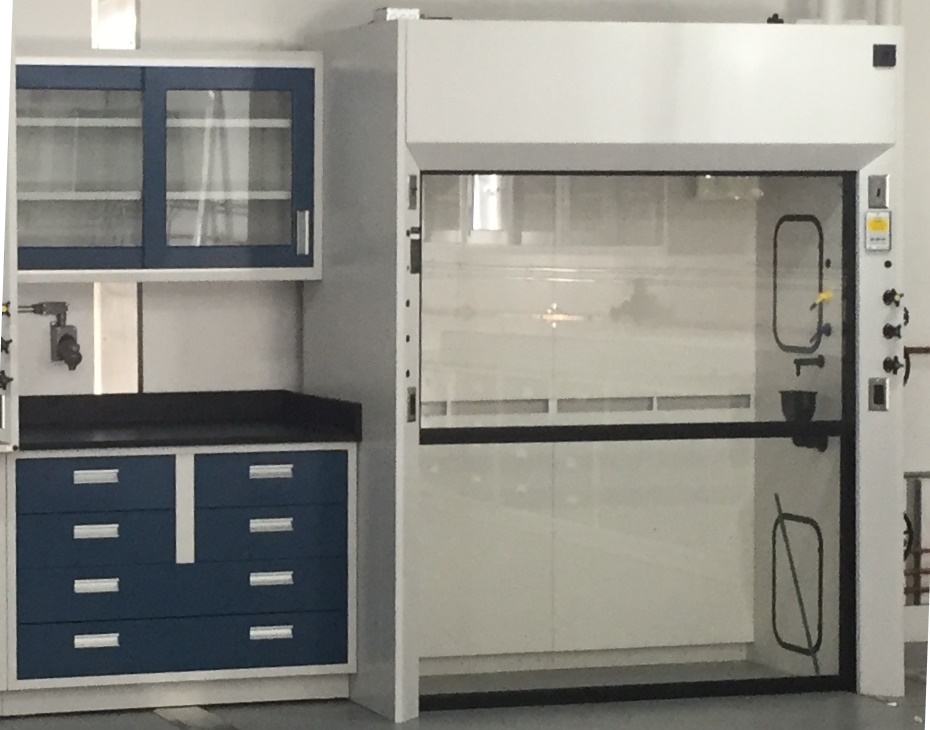
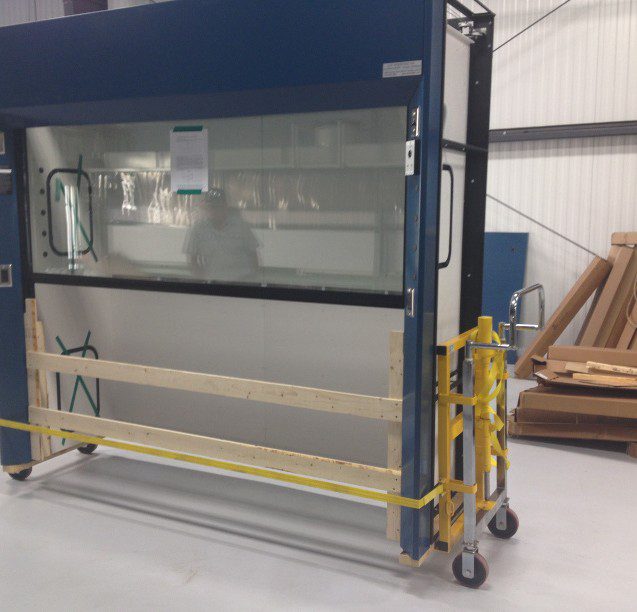
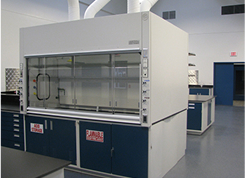
The walk-in hood from LOC Scientific is an important solution for laboratories that need to accommodate large equipment or complex setups. Designed with two vertically rising sashes, this fume hood cabinet allows you to roll in large apparatus or portable workstations with ease.
Its expansive design suits labs that need more space and flexibility while maintaining safety and airflow control.
Ready to specify one? Review the model table below, then request a design or call us at 770-932-0202. For background on how these hoods work, read our walk-in fume hood guide.
About Our Walk-In Hood
The walk-in hood is equipped with two full-view, vertically rising sashes that allow you to roll in large equipment or portable workstations without obstruction. Each sash is made from 7/32" laminated safety glass, providing visibility and added protection during use, with full-width flush PVC pulls ensuring smooth operation.
Advanced Walk-In Hood Features
Dual-sash design engineered for large equipment access with safety and airflow control.
Two vertically rising sashes operate independently for maximum access flexibility.
Easily accommodate oversized apparatus and portable workstation entry.
75, 100 and 125 FPM options for diverse laboratory requirements.
Audible airflow monitoring helps confirm proper ventilation for safety.
7/32" laminated safety glass sashes with full-width flush PVC pulls.
Inward-angled entrance minimizes turbulence (60-150 FPM range).
Resin-Chem liner and exterior panels are removable for easy maintenance.
Sealed lighting system with easy top-front tube replacement.
Walk-In Hood Applications and Environments
Our walk-in hood provides large-scale containment across demanding laboratory environments that need oversized equipment access
Research & Development Labs
Accommodate large experimental apparatus, pilot-scale equipment and complex multi-component research setups that need containment.
Industrial Testing Facilities
Handle oversized testing equipment, large sample preparations and industrial-scale quality control procedures.
Educational Institutions
Support teaching laboratories with large demonstration equipment and group experimental setups that need safety containment.
Pharmaceutical Manufacturing
Contain large-scale synthesis equipment, pilot production apparatus and oversized pharmaceutical processing equipment.
Chemical Processing Labs
Accommodate bulk chemical handling equipment, large reaction vessels and industrial chemical analysis apparatus.
Materials Science Research
Handle large material testing equipment, furnaces and specialized processing apparatus that require fume extraction.
Benefits of Choosing a Walk-In Hood
Dual vertically rising sashes provide unobstructed access for large apparatus and portable workstations.
75, 100 and 125 FPM settings accommodate diverse laboratory procedures and safety requirements.
The LOC500 audible airflow monitor helps verify protective ventilation.
Inward-angled entrance design minimizes turbulence for optimal containment (60-150 FPM range).
Removable Resin-Chem liner and exterior panels facilitate thorough cleaning and maintenance.
Design features help reduce energy consumption while maintaining safety performance.
Optional service fixtures and fan options tailor the hood to specific laboratory requirements.
Double-wall construction with chemical-resistant materials supports reliable long-term performance.
Walk-In Hood Technical Specifications
and Performance Data
Walk-In Hood Model Specifications
| Model # | Hood Size | Collar Size | 75 FPM CFM | 75 FPM SP | 100 FPM CFM | 100 FPM SP | 125 FPM CFM | 125 FPM SP |
|---|---|---|---|---|---|---|---|---|
B-664 |
48" |
8" Dia. |
731 |
.46 |
975 |
.82 |
1219 |
1.29 |
B-665 |
60" |
10" Dia. |
956 |
.27 |
1275 |
.63 |
1594 |
.99 |
B-666 |
72" |
12" Dia. |
1181 |
.29 |
1575 |
.51 |
1969 |
.88 |
B-667 |
84" |
(2) 10" Dia. |
1406 |
.23 |
1875 |
.42 |
2344 |
.65 |
B-668 |
96" |
(2) 10" Dia. |
1631 |
.28 |
2175 |
.51 |
2719 |
.79 |
Walk-In Hood Features
-
Walk-In Hood Features
Two independently operating, vertically rising sashes
-
Face Velocity Range
60-150 FPM with precise control options
-
Large Access Opening
Accommodates oversized equipment and portable workstations
-
Safety Glass
7/32" laminated safety glass with full-width flush PVC pulls
-
Airflow Monitoring
LOC500 audible monitor for continuous safety verification
-
Construction
Double-wall design with Resin-Chem chemical-resistant liner
Performance Features
-
Variable CFM Options
Three face velocity settings for diverse applications
-
Energy Efficiency
Advanced airflow design helps reduce operating costs
-
Equipment Accommodation
Roll-in access for large apparatus and workstations
-
Smooth Operation
Inward-angled entrance minimizes turbulence
-
Maintenance Access
Removable panels for easy cleaning and service
Installation Notes
- Static pressures listed are for hoods only; the additional duct system pressure drop must be calculated.
- Total pressure drop through the hood and duct system determines proper exhaust blower selection.
- Room size, heat load and air change requirements must be considered for proper sizing.
- Optional service fixtures require specification of locations for mounting hole preparation.
How to Choose the
Right Walk-In Hood
- Measure your apparatus. Note the height, width and depth of the largest item or portable workstation you plan to roll in, then pick the hood size (48 to 96 inches) that fits it with working clearance.
- Select a face velocity. The table lists airflow at 75, 100 and 125 FPM. Match the setting to your procedures and your safety officer’s requirements.
- Read the airflow and static pressure. Use the CFM and SP columns for your model, then add the pressure drop of your duct system to select the exhaust blower.
- Plan the accessories. Decide on the exhaust fan, airflow monitor and any service fixtures, and specify fixture locations so mounting holes can be prepared.
- Check the room. Room size, heat load and air change requirements all affect proper sizing.
- Request a design. Send us your equipment dimensions and duct plan, and our team will help you confirm the right model.
Work practices matter as much as specifications. Prudent Practices in the Laboratory advises that no one should walk into a chemical hood while it is operating and contains hazardous chemicals. Our sizing, ducting and installation guide explains how to plan around that.
Why Choose LOC Scientific?
LOC Scientific builds walk-in hoods to meet the unique needs of your laboratory. Our hoods use high-quality materials and deliver robust safety features, long-lasting durability and dependable performance.
From design to installation, our team offers expert guidance and support throughout the entire process. With energy-saving features and custom options, our walk-in hood is designed to help you control operating costs while maintaining safety and performance for oversized laboratory equipment.
Accessories for Your Walk-In Hood
- Fume hood exhaust fans to move air through the duct system
- Fume hood monitors and airflow monitors for continuous ventilation checks
- Fume hood remote fixtures for services at your work area
- Scheduled maintenance programs
Related Documents
Request a Design for Your Walk-In Hood
Tell us about your equipment, face velocity target and duct plan, and we will help you choose the right model. Use our contact form to request a design, or call 770-932-0202.
Frequently Asked Questions
The model table lists five sizes: 48, 60, 72, 84 and 96 inches (models B-664 through B-668). Collar size, CFM and static pressure change with each model. Match the size to the largest apparatus or portable workstation you plan to roll in, and send us your equipment dimensions so we can confirm the right model.